



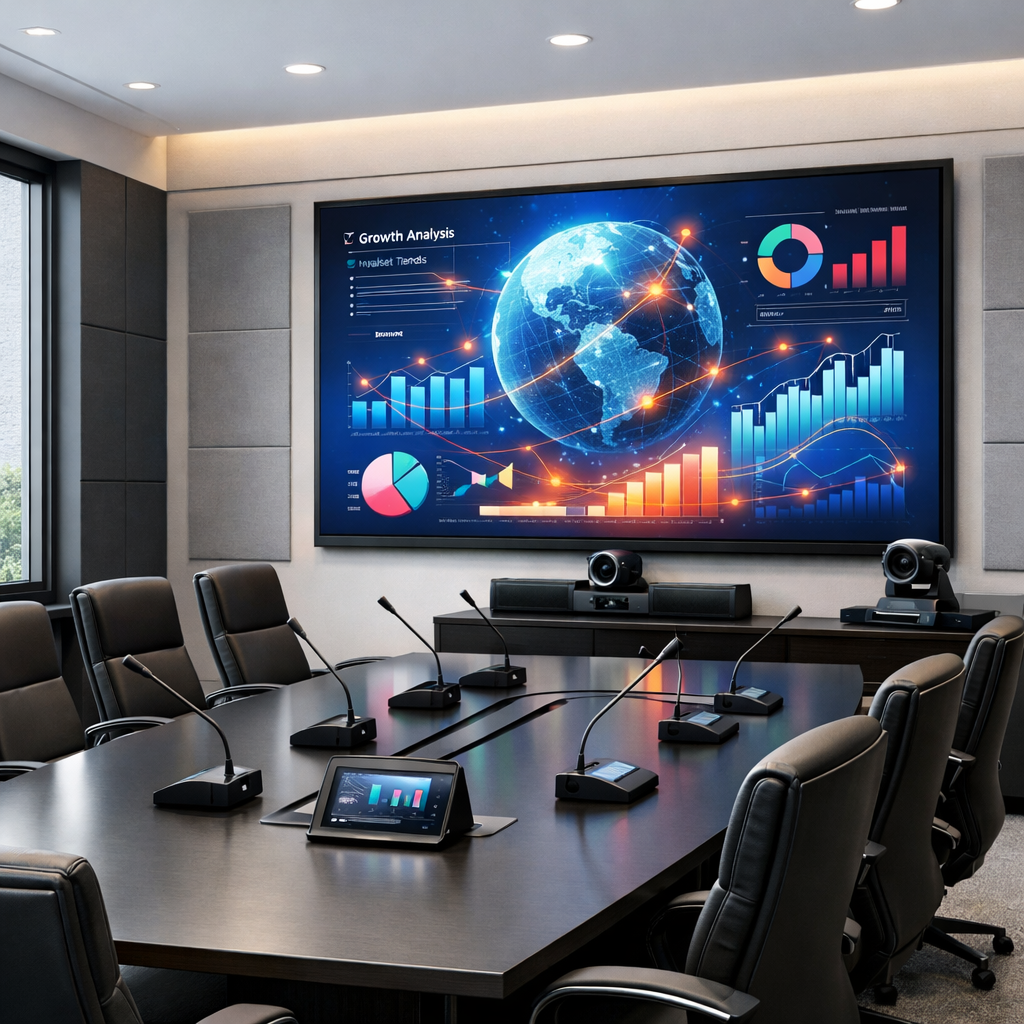
Audiovisual technology has always evolved faster than you can say “next slide please.”
Consider that the once-dominant king of business AV, the humble analog slide projector, rolled off the assembly line for the last time in 2004. The transition was swift: digital projectors replaced the hardware, while Microsoft PowerPoint replaced the carousel tray — eventually finding its way onto more than a billion computers worldwide.
Today, audiovisual technology plays an even larger role in business operations. For many organizations, AV has evolved from a simple conference room convenience into a core part of daily communication. Video conferencing, digital collaboration tools, presentation systems, and integrated displays now support everything from executive meetings and employee training to remote workforce coordination and customer engagement.
As companies expand across multiple offices, campuses, or facilities, the challenge is no longer simply installing equipment. The real challenge is ensuring that every location functions consistently and reliably.
Without standardized enterprise AV systems, organizations often end up managing a patchwork of equipment, interfaces, and support requirements across different locations. Over time, this lack of consistency can create operational inefficiencies, increased support costs, and frustrating user experiences.
“The stakes for proper standardization have never been higher,” Tim Albright wrote for AVNation. “As organizations increasingly rely on digital infrastructure to drive business value, the ability to effectively assess and adjust AV and IT standards becomes a critical differentiator between market leaders and followers.”
Enterprise AV standards provide a structured solution. By aligning equipment, design, and deployment practices across locations, businesses can create predictable performance, simplify support, and improve the overall efficiency of their communication environments.
What Are Enterprise AV Standards?
Enterprise AV standards refer to a defined framework for how audiovisual systems are designed, deployed, and supported across an organization.
Rather than allowing each office or project team to select its own technology stack, companies establish consistent guidelines for equipment types, room designs, integration methods, and operational processes.
These standards may include specifications for:
- Display types and sizes
- Video conferencing platforms and endpoints
- Control systems and user interfaces
- Audio equipment and microphone configurations
- Cable infrastructure and connectivity standards
- Network integration requirements
- Remote monitoring and management platforms
The goal is not to eliminate flexibility entirely. Instead, it is to create a predictable foundation that ensures every meeting room, collaboration space, or training facility operates in a familiar and reliable way regardless of location.
When properly implemented, enterprise AV standards allow organizations to scale technology deployments while maintaining operational consistency.
Operational Challenges of Non-Standardized AV Systems
Many organizations do not intentionally avoid standardization. Instead, their AV environments grow organically over time.
A new office installs one brand of display. A renovation project introduces a different control system. A regional team selects its own conferencing platform based on local preferences. After several years, the company may have dozens of AV configurations spread across its facilities.
This fragmented approach can create several operational problems.
First, the user experience becomes inconsistent. Employees who travel between offices may encounter different room interfaces, unfamiliar controls, or incompatible collaboration tools.
Second, troubleshooting becomes more complicated. IT and AV support teams must learn multiple platforms and maintain expertise across several systems.
Third, maintenance costs rise as spare parts, service contracts, and vendor relationships multiply.
Finally, technology refresh cycles become difficult to manage because equipment lifespans and upgrade paths vary from location to location.
Enterprise AV standards address these challenges by bringing structure and consistency to system design and lifecycle management.
Key Benefits of Enterprise AV Standardization
Standardizing AV systems across multiple locations provides tangible operational benefits for both technical teams and everyday users.
Some of the most significant advantages include:
- Consistent user experience: Employees can walk into any meeting room across the organization and immediately understand how the system works. This reduces delays at the start of meetings and improves collaboration.
- Simplified training and adoption: Standardized systems allow companies to develop uniform training materials and onboarding resources. Staff can learn one interface rather than several different configurations.
- Streamlined procurement: Standardization reduces the complexity of purchasing AV equipment. Organizations can negotiate preferred vendor relationships and bulk purchasing agreements.
- Predictable system performance: Using consistent hardware and integration practices helps ensure that systems perform reliably across all facilities.
- Faster deployment of new locations: When standards are already established, new offices can replicate proven AV designs rather than starting from scratch.
These benefits become especially valuable for organizations that operate across multiple cities, campuses, or regions.
Improving Monitoring and Service Efficiency
One of the most practical advantages of enterprise AV standards is the ability to monitor and service systems more efficiently.
When AV infrastructure is standardized, support teams gain greater visibility into system performance and health across the organization. Centralized monitoring platforms can track device status across multiple locations, allowing support teams to identify issues proactively before they affect meetings or presentations.
Because systems follow consistent designs, troubleshooting time is reduced and remote diagnostics and configuration updates become more straightforward. Support teams can also maintain standardized spare parts inventories, enabling faster repairs when hardware issues do arise.
Without standardized systems, support teams often face a confusing mix of hardware and control platforms. Diagnosing issues may require multiple tools, vendor contacts, or specialized expertise.
A standardized AV environment, by contrast, creates predictable infrastructure that can be monitored, serviced, and updated more efficiently from a centralized support model.
For large organizations with dozens or hundreds of meeting spaces, these efficiencies can significantly reduce operational costs and downtime.
AV Standards and Long-Term Technology Planning
Enterprise AV standards also support better long-term technology planning.
When AV environments are built around consistent system architectures, organizations can develop structured lifecycle management strategies. Equipment refresh cycles can be scheduled in phases, software updates can be deployed across multiple systems simultaneously, and infrastructure upgrades can follow predictable timelines.
Standardization also simplifies integration with other enterprise technologies. Modern AV systems increasingly interact with unified communications platforms, building management systems, network infrastructure, digital signage platforms, and collaboration and productivity software.
A standardized AV architecture ensures that these integrations are designed intentionally rather than added in an ad hoc manner. This approach helps organizations avoid compatibility issues while maintaining flexibility for future innovation.
Building an Effective Enterprise AV Standard
Developing a successful AV standard requires collaboration between multiple stakeholders, including IT teams, facilities management, and organizational leadership.
The process typically includes evaluating current AV environments, identifying common use cases, and defining system designs that can support the majority of operational needs.
Important considerations include:
- Room types and usage scenarios
- Network and security requirements
- Scalability for future growth
- Integration with collaboration platforms
- Serviceability and lifecycle management
By documenting these standards and applying them consistently across projects, organizations can transform AV systems from isolated installations into a cohesive enterprise technology platform.
This structured approach positions AV technology not as a collection of isolated installations, but as a scalable enterprise platform built to grow with the organization.
Partnering with Experts for Enterprise AV Deployment
Implementing enterprise AV standards requires more than simply selecting equipment. It involves careful system design, infrastructure planning, integration with existing networks, and long-term support considerations.
Hexatronic Integrated Technology brings more than two decades of experience delivering integrated infrastructure solutions for enterprise, healthcare, education, industrial, oil and gas, technology companies, data centers, and commercial environments.
Hexatronic helps organizations build technology ecosystems that perform reliably across multiple locations with services that include security, datacom, AV, DAS and electrical solutions.
Whether standardizing AV systems across a corporate campus or deploying collaboration environments for distributed teams, Hexatronic provides the expertise needed to design, implement, and support scalable enterprise AV infrastructure.
Contact Hexatronic Integrated Technology today to learn how enterprise AV standards can improve operational efficiency, simplify system management, and create consistent collaboration experiences across every location your organization operates.